

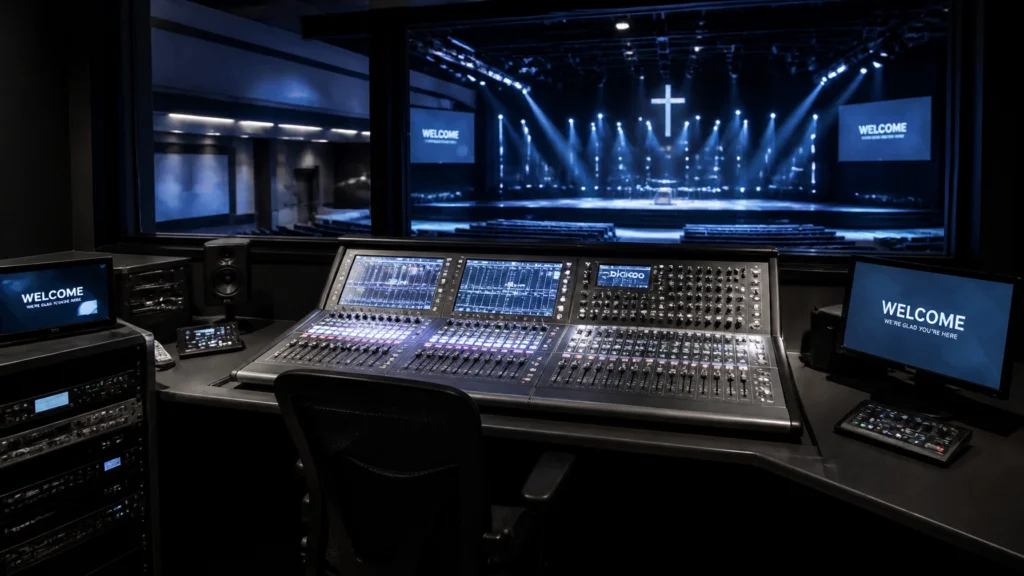
Maintaining high-quality audio in a house of worship requires regular equipment evaluation. As technical standards for live sound and digital broadcasting evolve, churches must adapt their hardware to meet current expectations for clarity and reliability. In 2026, the shift toward networked audio and volunteer-friendly digital interfaces has become the standard for modern worship environments.
This guide identifies seven key pro audio equipment upgrades necessary for church tech teams, volunteers, and worship leaders. Each recommendation balances professional-grade output with operational simplicity to ensure consistent performance.
1. Digital Mixing Consoles with Advanced Scene Recall
The transition from analog to digital mixing is essential for modern worship. Digital consoles allow for the storage and recall of specific settings for different services, bands, and vocalists. This feature is critical for churches that rely on volunteers with varying levels of technical expertise.
For 2026, the Allen & Heath SQ series and the Qu series are the primary recommendations for small to mid-sized sanctuaries. These consoles offer:
- 96kHz Processing: Provides high-resolution audio quality for both the room and the livestream.
- Volunteer-Friendly Layouts: Touchscreen interfaces and physical faders simplify navigation.
- Customizable Fader Layers: Allows tech teams to present only the necessary channels to volunteers, reducing the risk of operational errors.
When selecting a console, consider the number of auxiliary buses. Modern worship requires separate mixes for front-of-house (FOH), in-ear monitors (IEMs), and streaming feeds. For more information on digital hardware, refer to our comparison of analog vs. digital pro audio equipment.
2. Integrated Wireless and Wired In-Ear Monitors (IEMs)
Stage volume management is a primary challenge in many worship spaces. Floor wedges often create "audio bleed," which muddies the front-of-house mix and increases the risk of feedback. Transitioning to IEMs resolves these issues by allowing musicians to hear themselves through isolated earphones.

In 2026, a hybrid approach is recommended for cost-efficiency:
- Wireless IEMs (e.g., Shure PSM300 or Sennheiser EW IEM G4): These are prioritized for mobile members, such as the worship leader and vocalists.
- Wired IEMs (via Dante-enabled headphone amps): These are suitable for stationary musicians, including drummers and keyboardists. This setup reduces the complexity of RF management and lowers the overall system cost.
Implementing IEMs improves the experience for the congregation by allowing the FOH engineer to have full control over the house mix without competing with loud stage monitors.
3. Dante Audio Networking Infrastructure
Traditional analog snakes are being replaced by digital networking protocols, specifically Dante (Digital Audio Network Through Ethernet). A Dante network uses standard Cat6 cabling to transmit hundreds of audio channels between the stage, the console, and the streaming computer.

The functional benefits of Dante networking include:
- Reduced Cabling Complexity: A single network cable replaces heavy, expensive copper snakes.
- Scalability: Adding new endpoints, such as overflow rooms or additional stage boxes, requires only a network connection.
- Signal Integrity: Digital transmission eliminates the hum and interference often found in long analog cable runs.
Building a professional sound system now requires a reliable network backbone. JAMMIN' Sound Solutions assists churches in designing these networked architectures to ensure future-proof operation.
4. High-Performance Subwoofers for Low-Frequency Reinforcement
A common deficiency in church audio systems is inadequate low-end response. While many churches use full-range main speakers, dedicated subwoofers are necessary to reproduce the depth required for contemporary worship music.

Subwoofers, such as the QSC KS112 or high-output RCF models, provide the "chest-feel" clarity that prevents the mains from sounding thin. In 2026, active subwoofers with internal DSP (Digital Signal Processing) allow for easier integration and protection against overdriving. Proper placement and time alignment of these units are essential to prevent phase cancellation and "muddy" acoustics.
5. Dedicated Streaming and Broadcast Feeds
Providing a dedicated audio mix for online audiences is no longer optional. A mix designed for a sanctuary often sounds hollow or unbalanced when played through consumer speakers or headphones.
A professional streaming upgrade includes:
- Independent Broadcast Bus: A separate mix bus on the console specifically for the livestream.
- Hardware Encoders: Devices like the ATEM Mini Pro allow for integrated audio and video switching.
- Bus Processing: Dedicated compression and EQ on the broadcast feed ensure consistent loudness and clarity for online listeners.
JAMMIN' Sound Solutions provides the pro audio gear required to bridge the gap between live sound and high-quality digital broadcasting.
6. Professional Wireless Microphone Systems
Reliable wireless communication is fundamental to a successful service. In 2026, the RF (Radio Frequency) environment is increasingly crowded, necessitating the use of digital wireless systems that operate with greater spectrum efficiency.
Key considerations for wireless upgrades:
- Digital Transmission: Systems like the Shure QLX-D or ULX-D offer clear audio without the artifacts of analog companding.
- Antenna Management: Proper antenna distribution is required to prevent dropouts, especially in larger sanctuaries.
- Rechargeable Battery Systems: Reduces the long-term operational costs and environmental impact of disposable batteries.
For technical guidance on managing these systems, refer to our guide on how to choose the right antenna for your wireless setup.
7. Digital Stageboxes and Snakes
Digital stageboxes allow for the placement of microphone preamps directly on the stage. This converts the signal to digital data immediately, preserving signal quality and allowing for remote control of preamp gain from the mixing console.
Using a digital stagebox (such as the Allen & Heath DX168) in conjunction with a digital console simplifies the stage setup. This "plug-and-play" capability is advantageous for churches that must tear down and set up equipment weekly, such as those meeting in shared spaces.
Conclusion
Upgrading a church sound system is a technical necessity that directly impacts the clarity of the message and the quality of the worship experience. Focusing on digital consoles, IEMs, and networked audio provides the most significant return on investment in 2026.
JAMMIN' Sound Solutions specializes in providing high-quality pro audio gear and personalized service to help church tech teams achieve superior sound quality. Our specialists are available to consult on specific venue requirements and volunteer training needs.
For professional assistance with your next audio upgrade, contact JAMMIN' Sound Solutions via our contact page.