

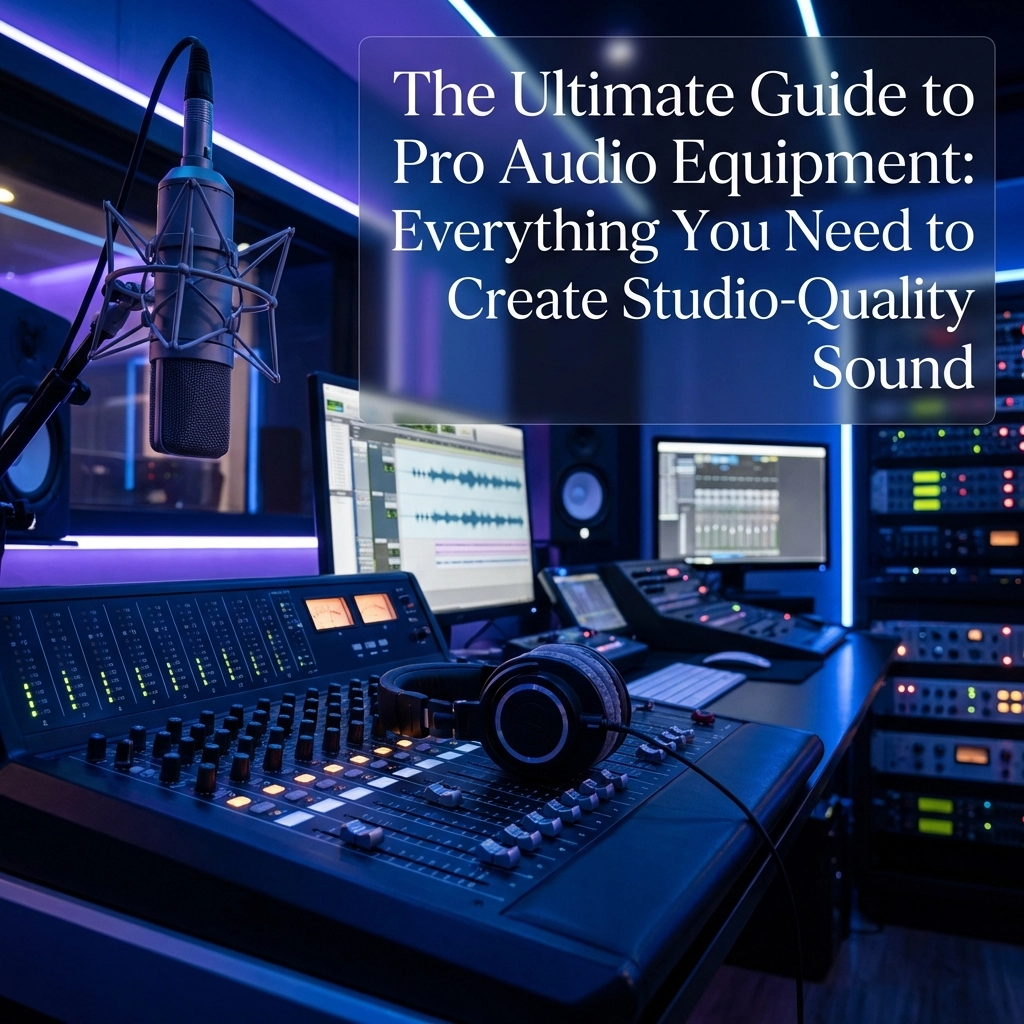
Achieving studio-quality sound requires more than talent: it demands the right pro audio equipment. Whether setting up a home recording studio, outfitting a church sanctuary, or preparing a venue for live performances, understanding the essential components of a professional sound system is fundamental. This guide covers the core categories of audio gear and provides a framework for making informed purchasing decisions.
Understanding Your Audio Requirements
Before visiting any music electronic store or browsing instruments websites, define the specific requirements for your setup. Recording studios, live venues, houses of worship, and touring musicians each have distinct needs that influence equipment selection.
Recording environments prioritize signal clarity, low noise floors, and accurate monitoring. Live sound applications require durability, high output capacity, and reliable performance under demanding conditions. Houses of worship often need versatile systems that accommodate spoken word, musical performances, and varying room acoustics.
Identifying these requirements first prevents costly mistakes and ensures every piece of instrument equipment serves a clear purpose.
Audio Interfaces: The Central Hub
An audio interface serves as the bridge between analog sound sources and digital recording systems. This device converts microphone and instrument signals into digital data that computers can process, then converts digital audio back to analog for monitoring.
Key specifications to evaluate include:
- Input/output count: Determines how many sources can be recorded simultaneously
- Preamp quality: Affects the clarity and character of recorded signals
- Sample rate and bit depth: Influences overall audio resolution
- Connectivity: USB, Thunderbolt, or other protocols determine compatibility with existing systems
Popular options range from entry-level two-channel units to professional interfaces with extensive routing capabilities. The Focusrite Scarlett series, Universal Audio Apollo, and Audient iD lines represent reliable choices across various budget ranges.
Microphones: Capturing Sound at the Source
Microphone selection directly impacts recording quality. Two primary categories serve most applications in professional sound solutions.

Dynamic microphones feature robust construction and handle high sound pressure levels effectively. These characteristics make them suitable for drums, guitar amplifiers, and live vocal applications. The Shure SM58 and SM57 remain industry standards for good reason: they deliver consistent performance across decades of use.
Condenser microphones offer greater sensitivity and extended frequency response. This sensitivity captures subtle details in vocals, acoustic instruments, and orchestral recordings. Large-diaphragm condensers excel in studio vocal applications, while small-diaphragm models suit acoustic instruments and overhead drum miking.
Essential microphone accessories include:
- Sturdy stands with secure grip mechanisms
- Pop filters for vocal recording
- Shock mounts to isolate microphones from vibration
- Windscreens for outdoor or high-airflow environments
Studio Monitors: Accurate Sound Reproduction
Studio monitors represent one of the most critical investments in any pro audio equipment setup. Unlike consumer speakers designed to enhance audio playback, studio monitors aim for flat frequency response: accurate reproduction of recorded material without coloration.
This accuracy matters because every mixing and mastering decision relies on what the engineer hears. Monitors that artificially boost bass or enhance highs lead to mixes that sound inconsistent across other playback systems.
Powered monitors integrate amplifiers directly into the speaker cabinet, simplifying setup and ensuring proper amplifier-to-driver matching. Most home studios and project facilities utilize powered monitors for this convenience.
Monitor placement significantly affects performance. Position monitors at ear level, forming an equilateral triangle with the listening position. Maintain consistent distance from walls to minimize boundary interference.
Headphones for Reference and Tracking
Professional headphones serve two distinct functions in audio production.
Closed-back headphones provide isolation during recording sessions. When vocalists or instrumentalists record overdubs, closed-back designs prevent monitor bleed into microphones. This isolation ensures clean recordings without artifacts from headphone leakage.
Open-back headphones offer a more natural soundstage for mixing and critical listening. The open design allows air movement around the drivers, typically resulting in less listener fatigue during extended sessions. However, sound leakage makes them unsuitable for tracking applications.
Many professionals maintain both types to address different workflow requirements.
Sound Systems for Live Performance

Live sound reinforcement presents challenges distinct from studio recording. Sound systems for musicians performing in venues must deliver sufficient output for the space while maintaining clarity across the frequency spectrum.
A complete live sound system typically includes:
- Main speakers (tops): Handle mid and high frequencies, project sound to the audience
- Subwoofers: Reproduce low frequencies that main speakers cannot efficiently produce
- Stage monitors: Allow performers to hear themselves and other band members
- Mixing console: Routes and processes all audio signals
- Signal processing: Equalizers, compressors, and effects units shape the final sound
Venues and touring productions scale these components based on audience size and acoustic requirements. Small clubs may require only a pair of powered speakers, while large venues demand line array systems with extensive subwoofer support.

Signal Processing Equipment
Outboard processing gear shapes audio signals beyond basic recording and playback. While software plugins replicate many functions, dedicated hardware processors remain standard in professional facilities.
Preamps amplify microphone-level signals to line level. Quality preamps add minimal noise while potentially imparting desirable sonic characteristics. Some designs emphasize transparency; others provide intentional coloration.
Compressors control dynamic range by reducing the volume of loud passages. This processing increases perceived loudness, adds sustain to instruments, and prevents signal clipping. Compression appears in virtually every professional recording and live sound application.
Equalizers adjust frequency balance. Graphic equalizers provide fixed frequency bands, while parametric designs offer adjustable center frequencies and bandwidth controls. Both types serve corrective and creative purposes.
Acoustic Treatment Considerations
Even the finest audio gear performs poorly in untreated spaces. Room acoustics significantly influence what engineers hear during recording and mixing.
Absorption panels reduce reflections from walls and ceilings. Strategic placement at first reflection points: the spots where sound bounces directly from monitors to listening position: improves stereo imaging and frequency accuracy.
Bass traps address low-frequency problems that absorption panels cannot control. Corners accumulate bass energy, creating uneven response throughout the room. Properly designed bass traps smooth this response.
Diffusers scatter sound energy rather than absorbing it. This treatment maintains a sense of space while reducing problematic reflections. Diffusion typically appears on rear walls in control rooms and studios.
Cables and Infrastructure
Signal cables connect every component in an audio system. While often overlooked, cable quality and organization affect both sound quality and reliability.
XLR cables carry balanced microphone and line-level signals. The balanced design rejects interference, making XLR connections standard for professional applications.
TRS cables (tip-ring-sleeve) handle balanced line-level signals and stereo headphone connections. Quarter-inch TRS cables connect many studio devices.
Instrument cables carry unbalanced signals from guitars, basses, and keyboards. These cables require shorter runs to minimize noise pickup.
Invest in quality cables from reputable manufacturers. Organize cables with ties, labels, and proper storage to extend their lifespan and simplify troubleshooting.
Building Your Setup Strategically
Budget constraints affect most equipment purchases. A strategic approach prioritizes components that most significantly impact results.
For recording applications, allocate resources first toward:
- Quality microphones appropriate for intended sources
- A reliable audio interface with clean preamps
- Accurate studio monitors
- Basic acoustic treatment
For live sound, prioritize:
- Main speakers sized appropriately for typical venues
- A mixing console with sufficient channels and routing
- Quality microphones for vocals and instruments
- Reliable cables and hardware
Expand systems incrementally as needs evolve and budgets allow. Starting with solid fundamentals creates a foundation for future growth.
Professional sound solutions require thoughtful equipment selection matched to specific applications. Whether purchasing from an audio sound store or researching options through instruments websites, understanding these core categories enables informed decisions. The right pro audio equipment transforms creative vision into professional-quality results.
For assistance selecting equipment for music production, live sound, or installation projects, JAMMIN' Sound Solutions provides expert guidance and professional-grade audio gear for every application.