

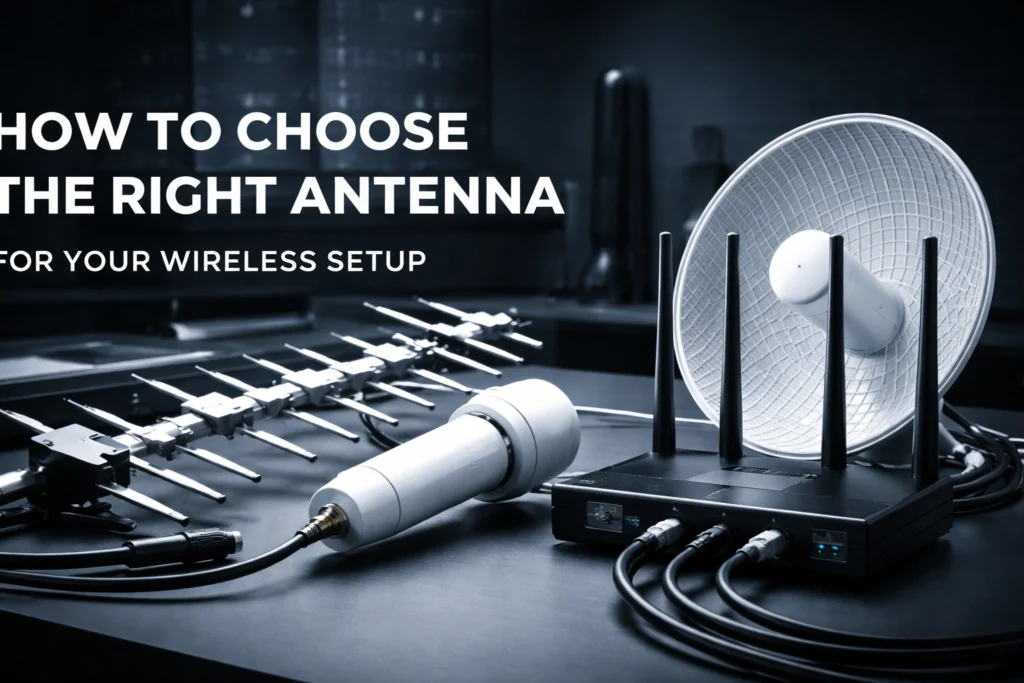
Wireless microphone systems and in-ear monitors have become standard pro audio equipment in live sound, broadcast, and house of worship applications. The performance of these systems depends heavily on one often-overlooked component: the antenna. Selecting the right antenna for a wireless setup directly impacts signal reliability, range, and overall system performance.
This guide covers the essential factors for choosing antennas that match specific wireless audio applications.
Why Antenna Selection Matters in Pro Audio
The stock antennas included with most wireless receivers serve basic functions but often fall short in demanding environments. Venues with metal structures, large audiences, or multiple wireless channels require more robust antenna solutions.
Poor antenna selection leads to dropouts, interference, and reduced range. These issues become critical during live performances where signal reliability is non-negotiable. Understanding antenna fundamentals allows audio professionals to build wireless systems that perform consistently across various environments.

Understanding Antenna Types for Wireless Audio
Several antenna types serve different purposes in professional sound solutions. Each design offers specific advantages depending on the application and venue characteristics.
Omnidirectional Antennas
Omnidirectional antennas radiate and receive RF signals in a 360-degree pattern around their vertical axis. These antennas work well when wireless transmitters move throughout a space or when the receiver location sits centrally within the coverage area.
Common applications include:
- Small to medium venues with centered receiver rack placement
- Situations where performers move throughout the entire stage area
- Installations where simplicity takes priority over maximum range
The trade-off with omnidirectional antennas involves reduced gain compared to directional options. This limitation becomes significant in larger venues or environments with substantial RF interference.
Directional Antennas
Directional antennas focus their reception pattern toward a specific area. This focused approach provides higher gain and improved signal-to-noise ratio within the coverage zone while rejecting interference from other directions.
Log-periodic dipole array (LPDA) antennas represent the most common directional option for wireless audio gear. These antennas offer consistent performance across wide frequency ranges, making them suitable for multi-channel wireless systems.
Directional antennas prove particularly effective for:
- Large venues where receivers sit at front-of-house positions
- Environments with significant RF interference from specific directions
- Applications requiring extended range between transmitters and receivers
Paddle Antennas
Paddle antennas combine directional characteristics with a compact form factor. These antennas mount easily on mic stands or rack systems and provide improved performance over stock whip antennas without requiring extensive installation.

Key Selection Criteria
Matching antenna specifications to system requirements ensures optimal performance. Several factors require consideration during the selection process.
Frequency Band Support
Antennas must support the specific frequency bands used by the wireless system. UHF wireless microphones typically operate between 470 MHz and 698 MHz, though exact ranges vary by region and regulatory requirements.
Verify that any antenna under consideration covers the full tuning range of the wireless receivers in use. Antennas designed for specific frequency blocks may not perform adequately outside their intended range.
Gain Specifications
Antenna gain measures how effectively the antenna concentrates RF energy compared to a reference antenna. Higher gain values indicate greater effective range and improved signal strength.
Gain specifications appear in dBd (decibels relative to a dipole) or dBi (decibels relative to an isotropic radiator). When comparing antennas, ensure measurements use the same reference standard.
Typical gain values for pro audio applications:
- Stock whip antennas: 0-2 dBd
- Paddle antennas: 3-5 dBd
- LPDA antennas: 5-7 dBd
- High-gain directional antennas: 7-10 dBd
Impedance Matching
Professional wireless audio equipment uses 50-ohm impedance standards. Antennas and coaxial cables must match this impedance to prevent signal loss and maintain system efficiency.
Mismatched impedance creates standing waves that reduce effective power transfer and can cause unpredictable performance issues.
Antenna Placement Considerations
Proper antenna placement often matters more than antenna selection. Even high-quality antennas perform poorly when installed incorrectly.
Line of Sight
RF signals travel most effectively along unobstructed paths. Position antennas where clear line-of-sight exists between the antenna and the transmitter locations.
Avoid placing antennas:
- Inside metal equipment racks
- Behind large metal objects or structural elements
- Below stage level when performers work on elevated platforms
Antenna Separation
Diversity wireless systems use two antennas per receiver to combat multipath interference. These antennas require adequate separation to function effectively.
Maintain minimum separation of one wavelength between diversity antenna pairs. For UHF frequencies around 600 MHz, this equals approximately 20 inches (50 cm).
Height and Angle
Elevated antenna positions generally improve coverage and reduce interference from audience absorption. Mount antennas at or above the height of transmitter positions whenever possible.
Directional antennas require proper aiming toward the coverage area. Tilt angles may need adjustment based on the vertical relationship between antenna and transmitter locations.

Signal Distribution Systems
Large wireless deployments benefit from centralized antenna systems that distribute RF signals to multiple receivers. These systems reduce cable runs, simplify antenna placement, and improve overall system organization.
Antenna Combiners and Splitters
Active antenna distribution systems amplify incoming RF signals and split them to multiple receiver inputs. This approach allows several receivers to share a single pair of antennas.
Key considerations for distribution systems:
- Ensure adequate gain to compensate for splitting losses
- Verify frequency coverage matches all connected receivers
- Calculate total cable losses and confirm system headroom
Coaxial Cable Selection
Cable quality and length directly impact signal strength at the receiver. Low-loss coaxial cables become essential for runs exceeding 25 feet.
RG-8X cable provides reasonable performance for moderate distances. Longer runs or critical applications warrant higher-grade options like LMF-400 or equivalent low-loss cables.
Calculate total cable loss based on frequency and distance. Excessive loss may require inline amplification or antenna relocation.
Common Antenna Mistakes
Several recurring errors compromise wireless system performance. Avoiding these issues improves reliability across instrument equipment and vocal microphone applications.
Using incompatible frequency ranges. Antennas designed for different frequency bands provide inadequate performance. Always verify compatibility before purchase.
Ignoring cable losses. Long coaxial runs without proper cable selection or amplification result in weak signals and reduced range.
Poor diversity spacing. Antennas mounted too close together defeat the purpose of diversity reception. Maintain proper separation distances.
Blocking antenna patterns. Equipment, cases, or structural elements between antennas and transmitters create dead zones and dropouts.
Overlooking gain requirements. Stock antennas may suffice for small rooms but fail in larger venues. Assess actual coverage needs before assuming included antennas will perform adequately.

Matching Antennas to Applications
Different venues and applications call for different antenna approaches.
Small clubs and rehearsal spaces typically work well with quality paddle antennas mounted on the receiver rack or nearby mic stands.
Houses of worship often benefit from directional antennas aimed at stage and altar areas, particularly when receivers sit at distant mix positions.
Theaters and concert venues may require distributed antenna systems with multiple antenna locations to ensure coverage across large stage areas.
Outdoor events present unique challenges including extended distances and lack of reflective surfaces. High-gain directional antennas and elevated mounting positions become essential.
Summary
Antenna selection significantly impacts wireless system reliability. Matching antenna type, gain, and frequency coverage to specific application requirements prevents common performance issues.
Proper installation practices: including line-of-sight positioning, adequate diversity spacing, and appropriate cable selection: maximize the benefits of quality antenna choices.
For assistance selecting antennas and signal distribution equipment for specific applications, the team at JAMMIN' Sound Solutions provides guidance on building reliable wireless systems for any venue or event type.