

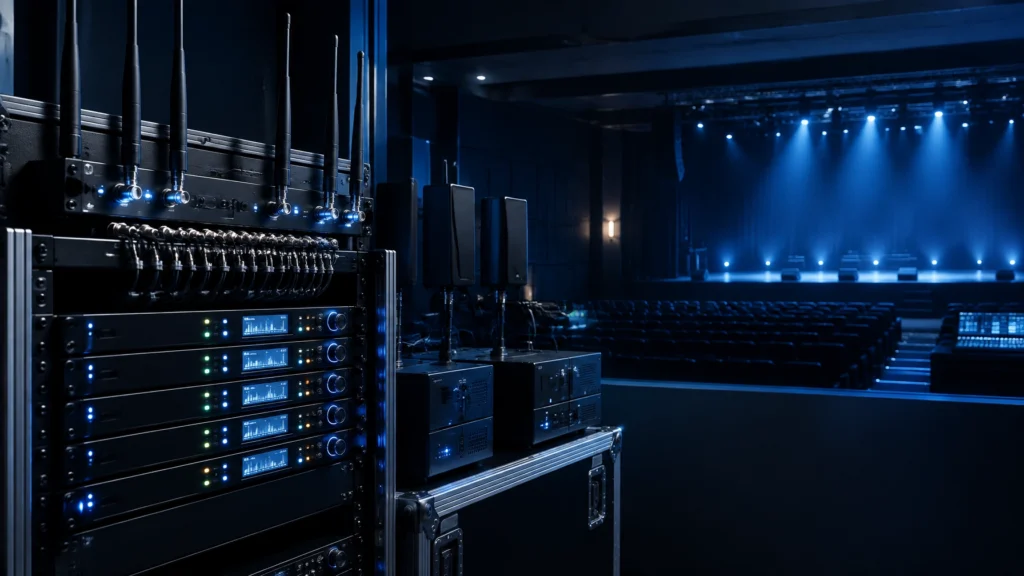
Wireless microphone systems remain essential components of venue sound systems. Churches, theaters, conference centers, touring productions, and live events often require multiple microphones, in-ear monitors, intercom channels, and control links to operate at the same time.
Traditional UHF systems continue to support most applications. Wireless Multichannel Audio Systems, or WMAS, introduce a different approach. Instead of assigning one narrowband RF carrier to each audio channel, WMAS places many audio channels within one coordinated wideband RF channel.
The correct choice depends on channel count, spectrum availability, regulatory conditions, equipment investment, and the venue’s existing wireless inventory.
Traditional Wireless Systems: How They Work
Traditional analog and digital wireless microphone systems generally use a separate RF carrier for each microphone or IEM channel. In UHF applications, each carrier typically occupies a narrow bandwidth. Systems are then coordinated across available frequencies to prevent interference and intermodulation.
Digital wireless systems improve audio quality, encryption, control, and spectrum use compared with older analog systems. However, most digital UHF systems still operate as multiple individual narrowband links. Each transmitter and receiver pair remains a separate RF channel within the larger system.
A traditional setup usually includes:
- Wireless handheld, lavalier, or bodypack transmitters
- Individual receiver channels
- Receiver antennas and antenna distribution
- RF coordination software or hardware
- Rack space, power distribution, and network control
- Frequency plans for the venue and surrounding RF environment
This architecture is familiar and widely supported. It also creates limitations as the channel count increases.

The Main Limitations of Traditional UHF Wireless
Frequency coordination
Each narrowband channel must be selected to avoid:
- Local television transmissions
- Other wireless microphone systems
- Intermodulation products
- Nearby broadcast or event operations
- Harmonics and unwanted emissions
- RF noise from digital equipment
A frequency plan that works in one location may not work in another. Large venues and touring productions require regular spectrum scans and coordination updates.
Spectrum congestion
Available UHF spectrum has become more limited in many regions. In the United States, the digital television transition and 600 MHz repack removed former TV channels from wireless microphone use. Wireless systems may still operate in permitted portions of the TV bands, but the available operating space is more constrained.
Spectrum congestion affects both licensed and unlicensed users. A venue may have fewer usable frequencies than its existing equipment requires.
Limited channel density per rack
Traditional systems scale by adding receiver channels. This increases:
- Rack space
- Antenna distribution requirements
- Power consumption
- Network connections
- Coordination work
- Hardware and maintenance costs
Digital systems can provide improved channel density, but they still require a receiver path for each wireless link. A high-channel-count installation can become physically complex.
Additional planning information is available in JAMMIN’ Sound Solutions’ guide to wireless microphone frequencies and its article on avoiding RF interference.
What Is WMAS?
WMAS is a digital wideband wireless architecture designed for microphones, IEMs, talkback systems, and other professional audio applications.
Instead of treating every microphone as an independent narrowband RF carrier, WMAS uses one wider RF channel to carry multiple audio channels. The system allocates time, frequency, or both between users within that wider block.
Common WMAS technologies include:
- Wideband digital transmission
- Multi-carrier modulation
- OFDM-based signal processing
- Time Division Multiple Access
- Frequency Division Multiple Access
- Dynamic allocation of audio resources
- Centralized RF and DSP management
The practical difference is architectural. Traditional systems place many separate carriers next to one another. WMAS manages many audio channels as a single coordinated RF system.
Under current U.S. rules, WMAS can operate in permitted wireless microphone bands. In the TV bands, a WMAS system can use a channel up to 6 MHz wide and must be capable of at least three audio channels per MHz. Outside the TV bands, licensed WMAS operation can use wider bandwidths where regulations permit.
The FCC Report and Order on WMAS provides the relevant U.S. regulatory framework. Technical background is also available in Shure’s WMAS overview and the ETSI technical report.
WMAS Advantages
Higher spectrum efficiency
WMAS is intended for applications that require many simultaneous wireless channels in limited spectrum.
The FCC requires a WMAS system to support a mode capable of at least three audio channels per MHz. Actual channel capacity depends on the manufacturer, bandwidth, audio quality settings, modulation method, and product design.
Some current high-end digital narrowband systems already achieve strong spectrum efficiency. WMAS does not automatically outperform every digital system in every configuration. Its advantage is the ability to manage a larger number of channels within one coordinated wideband block.
Simplified system coordination
A WMAS base station can manage microphone and IEM resources within one system architecture. This can reduce the number of independent frequencies that must be planned and monitored.
It does not eliminate frequency coordination. The system still requires a suitable block of clean spectrum, proper antenna design, and compliance with local regulations. It can reduce coordination complexity when the venue has a high channel count and enough contiguous spectrum.
High channel counts
WMAS is designed for environments such as:
- Large houses of worship
- Theaters and performing arts venues
- Conference and convention centers
- Broadcast and production facilities
- Touring productions
- Sports and entertainment venues
- Large corporate event spaces
A single wideband system can support microphones and IEMs within the same broader RF allocation, depending on the product and regional rules.
Low latency options
Latency is product-specific. It depends on codec design, RF processing, audio routing, and operating mode.
WMAS systems can provide latency suitable for live vocals, stage monitoring, and IEM applications. Sennheiser has publicly demonstrated a WMAS IEM configuration with approximately 0.7 milliseconds of latency under a specified operating mode. Traditional digital wireless systems can also provide low latency, so latency should be compared using published specifications rather than system category alone.
Centralized management
WMAS typically places more intelligence in the base station. This can simplify monitoring, firmware management, channel assignment, and system configuration.
A centralized architecture can also make troubleshooting more structured. The trade-off is that the base station becomes a critical part of the system. Redundancy, backup planning, and service support become important.
WMAS Limitations and Trade-Offs
Higher initial cost
WMAS equipment is generally positioned as professional, high-channel-count infrastructure. The base station, transmitters, receivers, antennas, and control hardware can cost more than a small traditional UHF system.
The investment may be justified when it replaces multiple racks of narrowband equipment. It is less likely to be justified for a venue using four or six wireless microphone channels.
Regional regulatory differences
WMAS availability depends on national regulations, frequency allocations, and certification requirements.
The FCC permits licensed and unlicensed WMAS operation under specified conditions in the United States. Europe uses an ETSI and CEPT framework, with national implementation affecting practical deployment. Availability in Asia-Pacific and other regions varies.
A system approved in one country may not be legal or fully supported in another. Frequency range, output power, bandwidth, licensing, and operating restrictions must be confirmed before purchase.
Smaller vendor ecosystem
Traditional UHF wireless systems are available from many manufacturers. Rental houses, integrators, technicians, and touring crews are familiar with their operation.
WMAS has a smaller and newer ecosystem. The available product choices, rental inventory, third-party accessories, service procedures, and technician familiarity may be more limited. This matters for touring systems and venues that depend on local replacement equipment.
Backwards compatibility
WMAS is not automatically compatible with existing narrowband transmitters and receivers. A venue may need to replace or retain separate infrastructure during a transition period.
WMAS and traditional systems can be used in the same production, but they require careful coordination and adequate frequency separation. Existing antenna distribution, cabling, network control, and rack hardware may not transfer directly.
Learning curve
WMAS centralizes more functions within the base station and control software. Operators must understand:
- Wideband channel allocation
- System capacity modes
- Audio resource management
- RF coverage
- Antenna placement
- Firmware and network requirements
- Regional operating restrictions
The setup may be more efficient after training, but the initial configuration is not always simpler.
WMAS vs Traditional Wireless: Comparison
| Factor | Traditional UHF and Digital Wireless | WMAS |
|---|---|---|
| RF architecture | Separate narrowband links | Multiple channels within one wideband block |
| Best channel count | Low to medium | Medium to very high |
| Spectrum efficiency | Good to very good, depending on system | Designed for high efficiency |
| Coordination | Required for each system and carrier | Required for the wideband block and surrounding systems |
| Initial cost | Broad range, including lower-cost options | Generally higher |
| Compatibility | Widely supported | Limited to compatible WMAS hardware |
| Regional availability | Broad | Developing and region-dependent |
| Battery life | Product-specific | Product-specific; no automatic advantage |
| Latency | Low on modern digital systems | Can be very low, depending on product |
| Ideal use | Small venues, moderate channel counts, mobile setups | Dense installations and complex productions |
Which System Is Right for a Venue?
Choose traditional UHF or digital wireless when:
- The venue requires a limited number of wireless channels.
- Existing inventory already meets production needs.
- Budget and straightforward deployment are priorities.
- The venue operates in a region without WMAS approval.
- Rental and replacement compatibility are important.
- Systems must be deployed quickly across different locations.
- Narrowband systems are already integrated with the venue’s antennas and control infrastructure.
Traditional digital wireless remains a suitable choice for many churches, small theaters, corporate events, houses of worship, and live sound systems.
Consider WMAS when:
- The venue regularly uses a high number of microphones and IEMs.
- Spectrum availability is restrictive.
- Multiple racks of narrowband equipment are becoming difficult to manage.
- A permanent installation justifies centralized infrastructure.
- The venue has trained RF and network technicians.
- The selected system is approved for the operating region.
- The vendor provides service, firmware support, accessories, and long-term availability.
WMAS is most relevant when spectrum efficiency and channel density are operational requirements rather than optional features.
A Practical Buyer’s Framework
Before selecting a wireless system, document the following:
-
Current channel count
List microphones, IEMs, talkback channels, assistive listening systems, and future requirements. -
Available spectrum
Complete an RF scan at the venue. Identify television, broadcast, cellular, and other local users. -
Growth requirements
Determine whether the venue will need substantially more channels within three to five years. -
Existing infrastructure
Review antennas, distribution systems, rack space, cabling, networking, and power capacity. -
Regional compliance
Confirm permitted bands, licensing requirements, operating power, and product certification. -
Operational support
Evaluate technician training, manufacturer support, firmware policy, replacement hardware, and rental availability. -
Total cost of ownership
Include transmitters, receivers, base stations, antennas, batteries, accessories, software, service, and installation. -
Migration strategy
Decide whether the venue will replace its current system, operate both technologies, or deploy WMAS only for high-density areas.
Broader system planning can be reviewed in the professional sound system guide, the guide to choosing antennas for wireless setups, and the article on setting up a wireless IEM system.
Conclusion
Traditional UHF and digital wireless systems remain the practical choice for many venues. They offer broad availability, established workflows, extensive compatibility, and flexible pricing.
WMAS is designed for higher-density professional applications. Its primary benefit is efficient use of limited RF spectrum through centralized wideband operation. It can reduce system complexity when many microphones and IEM channels are required, but it does not eliminate frequency coordination or the need for qualified system design.
For most buyers, the decision should begin with channel count, spectrum conditions, regional approval, and existing infrastructure. WMAS is appropriate when the venue has a clear need for high channel density. Traditional wireless remains the more efficient investment for smaller systems and established installations.