

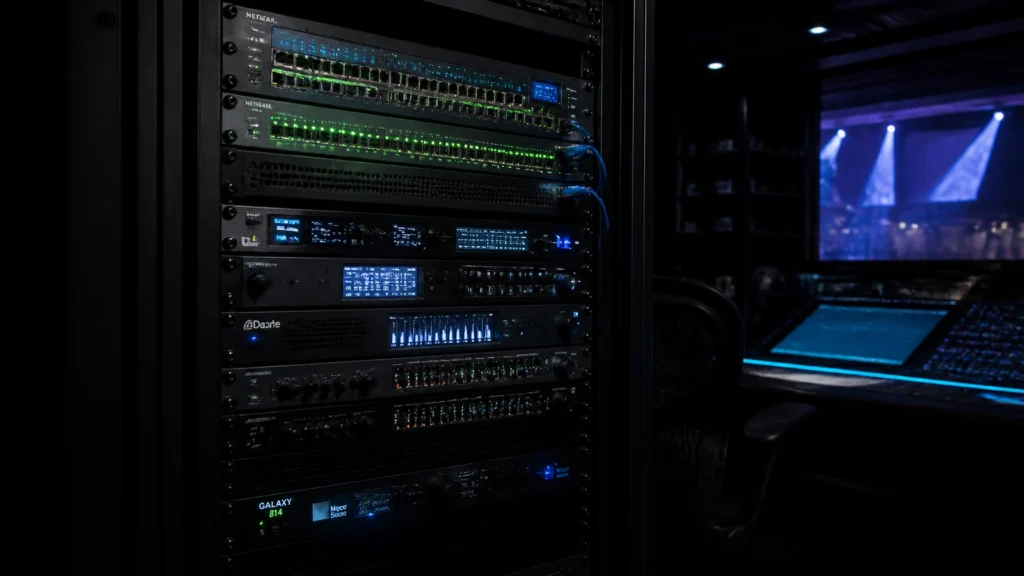
Modern venue sound systems rely on digital audio networking protocols to manage high channel counts and complex routing. Choosing between Dante and Milan is a critical decision for venue owners and live sound engineers. Both protocols facilitate the transport of uncompressed digital audio over Ethernet networks, but they operate on fundamentally different technical principles. This article provides a technical comparison of Dante and Milan to determine which solution is most appropriate for professional-grade audio installations.
Technical Fundamentals: Layer 3 vs. Layer 2
Dante, developed by Audinate, is a proprietary Audio-over-IP (AoIP) protocol. It operates at Layer 3 of the OSI model. This allows Dante to function on standard Layer 3 network infrastructure. It uses IP packets to transport audio data, which enables routing across subnets and integration with standard IT networks.
Milan is a specialized profile of the Audio Video Bridging (AVB) and Time-Sensitive Networking (TSN) standards. It is an open standard maintained by the Avnu Alliance. Unlike Dante, Milan operates at Layer 2. It utilizes IEEE standards to define how audio data moves across the network. Because it is a Layer 2 protocol, it is restricted to the local network segment (broadcast domain) unless specific gateways are used.
Latency and Synchronization
Latency is the time required for an audio signal to travel from the source to the destination. In live sound environments, low and predictable latency is required to maintain phase coherence and timing.
- Dante Latency: Dante provides user-configurable latency. Engineers can set latency buffers ranging from 150 microseconds to 5 milliseconds or more. While Dante is highly stable, its latency is not mathematically deterministic. It depends on network traffic conditions and switch performance.
- Milan Latency: Milan utilizes the AVB/TSN standards to provide deterministic latency. The protocol reserves bandwidth specifically for audio streams. This ensures that audio packets arrive at their destination within a guaranteed time window, regardless of other network traffic.

Network Infrastructure Requirements
The choice of protocol dictates the type of hardware required for the network backbone. This has significant implications for both cost and ease of implementation.
Dante Infrastructure
Dante is designed to work with standard, off-the-shelf Gigabit Ethernet switches. It does not require specialized hardware features at the switch level. However, for large-scale installations, managed switches are recommended. Key requirements for Dante-optimized switches include:
- Quality of Service (QoS) support for traffic prioritization.
- IGMP Snooping to manage multicast traffic.
- Disabling of Energy Efficient Ethernet (EEE) to prevent clocking issues.
Milan Infrastructure
Milan requires AVB-capable switches that support specific IEEE standards, such as IEEE 802.1AS (Timing and Synchronization) and IEEE 802.1Qav (Forwarding and Queuing). These switches are often more expensive and less common than standard IT switches. The advantage of this hardware requirement is that the switch automatically handles bandwidth reservation and traffic shaping. There is no need for manual QoS configuration.
Hardware Compatibility and Ecosystem
The availability of compatible hardware is a primary factor in system design. A protocol is only as useful as the devices that support it.
The Dante Ecosystem
Dante is the most widely adopted digital audio networking protocol. There are thousands of Dante-enabled products available from hundreds of manufacturers. This includes:
- Digital mixing consoles (Yamaha, Allen & Heath, DiGiCo).
- Power amplifiers and DSP units.
- Wireless microphone systems.
- Stage boxes and I/O interfaces.
This vast ecosystem makes it easy to build a comprehensive system using components from different brands. Furthermore, many Dante devices support AES67, an interoperability standard that allows Dante to communicate with other AoIP systems.
The Milan Ecosystem
The Milan ecosystem is smaller but focuses on high-end professional audio manufacturers. Key supporters include L-Acoustics, d&b audiotechnik, and Meyer Sound. Milan is often chosen for large-scale touring systems and prestigious permanent installations where these specific brands are utilized. However, the selection of compatible consoles and entry-level gear is more limited compared to Dante.

Ease of Use and Management
The management of a networked audio system requires software tools for discovery, routing, and monitoring.
Dante Controller
Dante uses a dedicated software application called Dante Controller. This software automatically discovers all Dante devices on the network. Routing is managed via a simple click-and-drag matrix. Dante Controller also provides tools for monitoring clock stability and network latency. The simplicity of this interface is a major factor in Dante's popularity.
Milan Management
Milan uses the IEEE 1722.1 (ATDECC) standard for device discovery and control. Because Milan is an open standard, management can be handled by various software tools provided by manufacturers. While the lack of a single, universal controller can increase complexity, Milan's automated QoS means that once devices are connected to an AVB switch, the network management is largely autonomous.
Redundancy and Reliability
For mission-critical venue applications, system failure is not an option. Both protocols offer mechanisms for redundancy.
- Dante Redundancy: Most professional Dante devices feature primary and secondary network ports. This allows for the creation of two physically separate networks. If the primary network fails, the devices switch to the secondary network without any interruption to the audio.
- Milan Redundancy: Milan also supports stream redundancy. It utilizes the capabilities of the underlying AVB/TSN infrastructure to ensure that audio streams are protected against network faults.
Comparison Summary Table
| Feature | Dante | Milan (AVB) |
|---|---|---|
| OSI Layer | Layer 3 (IP) | Layer 2 (Ethernet) |
| Switch Requirements | Standard Managed Gigabit | AVB/TSN Capable |
| Latency | Configurable (Low) | Deterministic (Guaranteed) |
| Ecosystem | 3,000+ Products | Select High-End Manufacturers |
| Interoperability | High (via Dante & AES67) | High (within Milan Certified) |
| Configuration | Manual (Dante Controller) | Automatic (Network Reservation) |
Selecting the Right Protocol for Your Venue
The decision between Dante and Milan depends on the specific requirements of the venue and the existing hardware preferences.
Choose Dante if:
- You require a wide selection of hardware from various manufacturers.
- You want to utilize existing standard network infrastructure.
- You need a system that is easy to configure and reconfigure frequently.
- You require interoperability with wireless microphone systems or other third-party gear.
Choose Milan if:
- You are standardizing on a high-end loudspeaker system from a Milan-supporting manufacturer.
- You require strictly deterministic latency for highly complex phase-critical applications.
- You are building a new, dedicated network and are willing to invest in AVB switches.
- You prefer an open-standard approach to network management.

Conclusion
Both Dante and Milan offer robust solutions for modern audio networking. Dante remains the industry standard due to its massive ecosystem and ease of use on standard IT hardware. Milan provides a specialized, high-performance alternative for environments where deterministic behavior is prioritized and AVB hardware is available.
For venue owners and engineers looking to upgrade their systems, JAMMIN' Sound Solutions provides expert consultation and professional-grade equipment for both Dante and Milan environments. Understanding the technical nuances of these protocols is the first step toward achieving superior sound quality and system reliability. For more information on building a professional sound system, refer to our complete guide.