

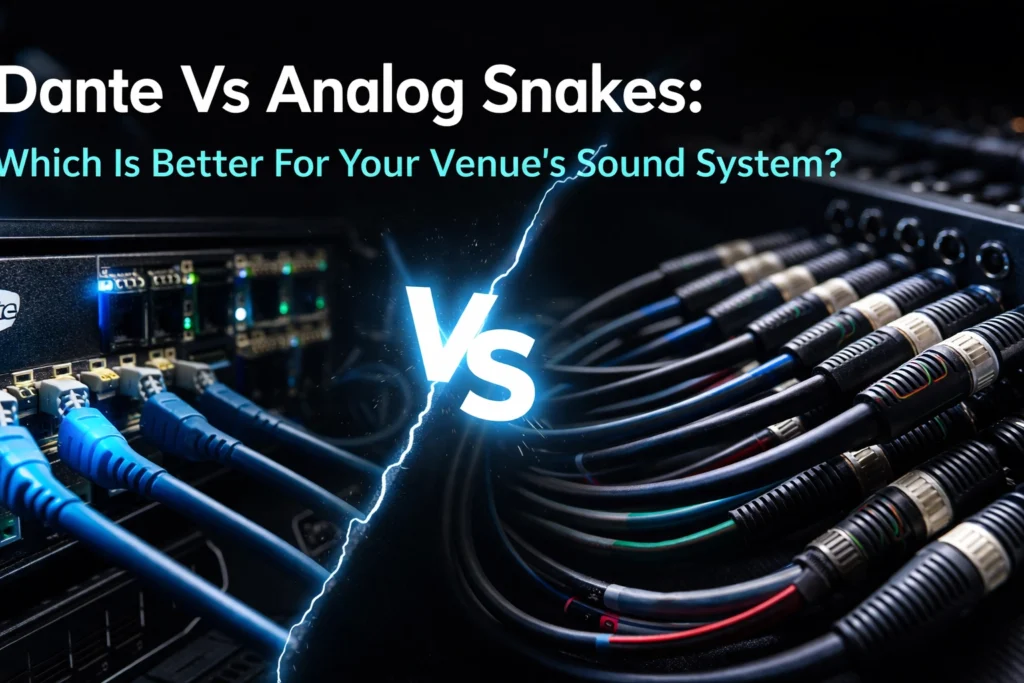
Selecting the right signal distribution method is one of the most consequential decisions when designing a venue's sound system. The choice between traditional analog snakes and modern Dante networking technology affects audio quality, installation complexity, operational flexibility, and long-term costs.
This comparison examines both technologies to help venue owners, system integrators, and audio professionals make informed decisions about their professional sound solutions.
Understanding Analog Snakes
Analog snakes have served as the backbone of live sound for decades. These multi-channel cable assemblies bundle multiple audio lines into a single, manageable unit. A typical analog snake consists of a stage box with XLR inputs, a heavy multi-conductor cable, and a fan-out at the front-of-house position.
The technology is straightforward. Each audio channel requires its own physical conductor within the snake. A 32-channel analog snake contains 32 separate signal paths, plus ground wires and shielding. This one-to-one relationship between channels and conductors defines both the reliability and the limitations of the format.
Analog snakes require no configuration software or network knowledge. Audio engineers connect microphones to the stage box, and signals appear at the corresponding outputs. This simplicity has value in certain applications.

Understanding Dante Audio Networking
Dante (Digital Audio Network Through Ethernet) represents a fundamentally different approach to audio signal distribution. Developed by Audinate, Dante transmits digital audio over standard Ethernet infrastructure using Cat5e or Cat6 cables.
A single Ethernet cable carrying Dante can transport up to 512 bi-directional audio channels. The audio travels as packetized data across the network, with sophisticated clock synchronization ensuring sample-accurate delivery at all endpoints.
Dante requires network switches, Dante-enabled devices, and configuration through Audinate's free Controller software. The learning curve exists, but the operational benefits are substantial for venues investing in sound systems for musicians and live events.
Audio Quality Comparison
Analog Snake Performance
Analog snakes transmit audio as continuous electrical signals. Signal quality depends on cable length, conductor quality, and environmental factors. Long cable runs introduce capacitance that attenuates high frequencies. Electromagnetic interference from lighting systems, power cables, and radio frequencies can induce noise.
Ground loops present another challenge. When multiple pieces of equipment connect to different electrical grounds, voltage differences create audible hum. Transformer-isolated splits address this issue but add cost and complexity.
Crosstalk between adjacent conductors within the snake can also occur, particularly with high channel counts and long runs.
Dante Performance
Dante converts audio to digital at the source and maintains that digital format throughout transmission. No signal degradation occurs regardless of cable length within Ethernet specifications. The audio quality at 300 feet matches the quality at 30 feet.
Digital transmission eliminates electromagnetic interference, crosstalk, and ground loop issues entirely. The signal either arrives perfectly or not at all: there is no gradual degradation.
For venues prioritizing pristine audio quality in their professional sound solutions, Dante offers measurable advantages.

Installation and Infrastructure
Analog Snake Requirements
Installing analog snakes requires significant labor. Each connection point needs proper termination: soldering or crimping individual conductors to connectors. A 48-channel snake has nearly 100 termination points, each representing a potential failure point and labor expense.
The physical bulk of analog snakes demands larger conduit runs for permanent installations. A 32-channel snake can measure over an inch in diameter, requiring substantial pathway infrastructure.
Setup and teardown for touring applications consumes considerable time. Analog snakes are heavy, require careful coiling to prevent damage, and offer no flexibility in signal routing without physical repatching.
Dante Infrastructure
Dante systems use standard IT infrastructure. Cat6 cables are thin, lightweight, and terminate with simple RJ45 connectors that require no specialized training. Network switches are commodity items available from multiple vendors.
Installation labor decreases substantially. Running a single Ethernet cable replaces the process of pulling heavy multi-pair cables. Termination involves a basic cable crimper rather than specialized audio soldering skills.
For touring applications, Dante reduces load-in time significantly. A single Ethernet cable connects the stage to front-of-house, replacing heavy copper snakes. Configuration changes happen in software rather than through physical repatching.
Scalability and Flexibility
Analog Limitations
Analog snakes have fixed channel counts. A 24-channel snake provides exactly 24 channels. Expanding capacity requires purchasing and installing additional snakes. Changing signal routing requires physical repatching at the stage box or console.
Adding a broadcast feed, recording split, or monitor world split multiplies the required cable infrastructure. Each split destination needs its own snake or transformer-isolated split system.
Dante Expansion
Dante networks scale by adding devices. Starting with 16 channels and needing 32 requires only connecting additional Dante-enabled equipment to the existing network. No new cable runs are necessary.
Signal routing changes happen through the Dante Controller software. Sending a channel to an additional destination involves a few mouse clicks rather than running new cables. This flexibility proves valuable for venues hosting varied events with different production requirements.
Multiple mix positions, broadcast feeds, and recording systems can access any channel on the network simultaneously without additional hardware splits.

Cost Analysis
Analog Snake Costs
Initial equipment costs for analog snakes appear competitive. However, the complete cost picture includes:
- Multi-pair cable (priced per foot, increases with channel count)
- Stage boxes and fan-outs
- Conduit and pathway infrastructure for permanent installations
- Labor for termination (often the largest expense)
- Transformer-isolated splits if multiple destinations are required
- Maintenance and repair of damaged conductors
Labor costs for proper analog snake installation can exceed the cost of the cable itself. Each termination point requires skilled work and testing.
Dante System Costs
Dante-enabled equipment sometimes carries a premium over analog-only equivalents, though this gap has narrowed considerably. The complete cost analysis includes:
- Dante-enabled stage boxes and interfaces
- Network switches (standard IT equipment)
- Cat6 cabling (significantly less expensive than multi-pair audio cable)
- Minimal termination labor
- Software (Dante Controller is free)
The labor savings during installation often offset any equipment price differences. Long-term operational flexibility adds value that is difficult to quantify but significant for active venues.
For guidance on building complete systems, the resource on how to build a professional sound system provides additional context.
Interoperability Considerations
Analog Compatibility
Analog connections follow established standards. Any XLR microphone connects to any XLR input. This universal compatibility has value, particularly when interfacing with legacy equipment or accommodating guest engineers with their own audio gear.
Dante Ecosystem
Dante has achieved broad industry adoption. Major manufacturers including Yamaha, Shure, Allen & Heath, and dozens of others offer Dante-enabled products. Devices from different manufacturers discover each other automatically on the network and integrate without compatibility concerns.
This interoperability extends to control functions. A Yamaha console can discover and control Shure wireless receivers on the same Dante network, centralizing system management.
For deeper exploration of digital versus analog technology choices, the comparison of analog vs digital pro audio equipment provides relevant information.

Making the Decision
When Analog Makes Sense
Analog snakes remain appropriate for:
- Simple, fixed installations with minimal expansion requirements
- Facilities lacking IT infrastructure or network expertise
- Situations requiring guaranteed compatibility with legacy equipment
- Budget-constrained projects where existing analog equipment is already owned
When Dante Excels
Dante provides clear advantages for:
- New installations where infrastructure costs favor network cabling
- Venues requiring flexibility for varied event types
- Facilities needing multiple mix positions or broadcast capabilities
- Organizations planning phased system expansion
- Applications where audio quality over long distances is critical
Conclusion
Dante technology offers objective advantages over analog snakes for most modern venue applications. Superior audio quality, simplified installation, operational flexibility, and scalability position Dante as the preferred choice for new professional sound solutions.
Analog snakes retain relevance in specific situations, but the trajectory of the industry clearly favors networked audio. Venues investing in new sound systems for musicians and live events benefit from evaluating Dante as the primary signal distribution method.
For assistance selecting appropriate audio gear for specific venue requirements, contact JAMMIN' Sound Solutions for professional consultation.