

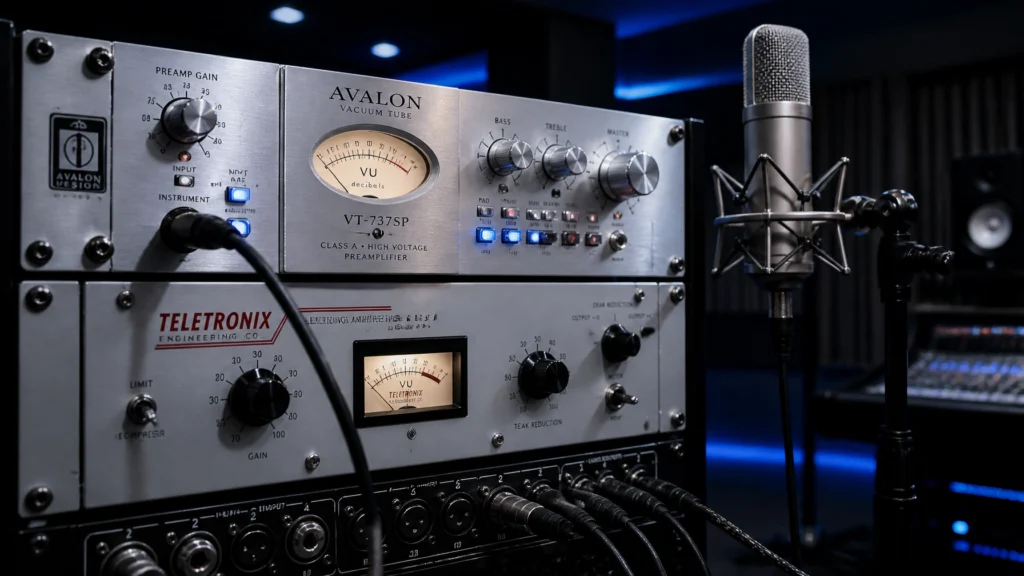
A signal chain represents the sequential path an electrical audio signal follows from the initial source to the final output. For musicians and audio engineers, the configuration of this chain determines the clarity, fidelity, and overall quality of the sound produced. Understanding the technical requirements of each stage is essential for optimizing pro audio equipment and ensuring professional sound solutions.
This guide details the fundamental components, optimal configurations, and best practices for managing signal chains in both live and studio environments.
Core Components of a Professional Signal Chain
A standard signal chain consists of several critical stages. Each piece of audio gear must be correctly integrated to maintain signal integrity and prevent noise floor issues.
1. Input Sources and Transducers
The signal chain begins with the source. This is typically a transducer, such as a microphone or a guitar pickup, which converts physical energy into an electrical signal.
- Microphones: Capture acoustic energy. These signals are low-voltage (mic level) and require significant amplification.
- Instruments: Electric guitars and basses produce high-impedance signals (instrument level). Proper matching is required to avoid frequency loss.
- Playback Devices: Computers, samplers, and synthesizers often output at line level, which is the standard operating voltage for most professional audio equipment.
2. Preamplification
The preamplifier is the first active electronic stage in the signal chain. Its primary function is to boost mic-level or instrument-level signals to line level. A high-quality preamp ensures that the signal is loud enough for processing without introducing excessive noise or distortion. In professional sound systems for musicians, preamps may be found in standalone rack units, mixing consoles, or audio interfaces.
3. Signal Processing: Dynamics and EQ
Once the signal reaches line level, it undergoes processing to shape the tone and control the dynamic range.
- Equalization (EQ): Used to adjust the balance of frequency components. Corrective EQ removes unwanted frequencies, while creative EQ enhances specific tonal characteristics.
- Dynamics Processing: This includes compressors, limiters, and gates. Compressors reduce the dynamic range to ensure consistency, while limiters prevent signal peaks from clipping.

Building a Live Sound Signal Chain
In a live environment, the signal chain must be robust and scalable. The complexity increases as more inputs and outputs are added to the system.
Integration with Mixing Consoles
The mixing console serves as the central hub. Signals enter through the channel inputs, pass through internal preamps, and are routed through the channel strip (EQ and dynamics) before being sent to the master bus. For venues requiring professional sound solutions, the console often manages multiple monitor mixes and front-of-house (FOH) outputs simultaneously.
Power Amplification and Speaker Systems
The final stage of the live signal chain is the output. Line-level signals from the mixer must be amplified to drive loudspeakers.
- Active Systems: These speakers have built-in power amplifiers and crossovers. They simplify the signal chain by integrating the amplification and processing within the speaker cabinet.
- Passive Systems: These require external power amplifiers. The signal chain includes the amplifier and often a dedicated system processor to manage crossovers and protection limiting.

JAMMIN' Sound Solutions provides a variety of pro audio equipment designed for these high-demand environments, including RCF and Turbosound systems that ensure high-fidelity output at the end of the chain.
Signal Chains for Studio Recording
Studio signal chains prioritize detail and transparency. The goal is to capture the source with maximum fidelity for later manipulation.
Digital Conversion
In modern recording, the signal must be converted from analog to digital (A/D conversion) to be processed by a Digital Audio Workstation (DAW). The quality of the converters in an audio interface directly impacts the clarity of the recorded audio. Once inside the DAW, the signal chain continues with software-based plugins, which emulate traditional hardware processors.
Monitoring Path
The studio signal chain also includes a monitoring path. This consists of Digital-to-Analog (D/A) converters, a monitor controller, and studio monitors. Accurate monitoring is necessary to make informed decisions regarding the signal chain's processing stages.
Optimizing Signal Integrity
Maintaining a clean signal throughout the chain requires attention to technical details such as gain staging and impedance matching.
Proper Gain Staging
Gain staging is the process of managing the signal level at each stage of the chain to maximize the signal-to-noise ratio while preventing clipping. Each device in the chain has an optimal operating range. If the signal is too low, the noise floor becomes audible. If the signal is too high, the hardware will distort or "clip."
Cable Management and Impedance
The physical connections between audio gear are a common source of signal degradation.
- Balanced vs. Unbalanced: Balanced cables (XLR, TRS) are preferred for professional applications as they reject external electromagnetic interference.
- Impedance Matching: Connecting a high-impedance instrument to a low-impedance mic input without a Direct Injection (DI) box can result in "tone sucking," characterized by a loss of high frequencies and signal strength.

Guitar and Bass Pedalboard Signal Chains
For musicians using effects pedals, the order of devices significantly alters the final tone. While creative experimentation is common, a standard functional order exists:
- Filters and Pitch: Wah-wah and octaver pedals are typically placed first to track the clean signal accurately.
- Dynamics: Compressors are placed early to even out the signal before gain stages.
- Gain Stages: Overdrive, distortion, and fuzz pedals follow.
- Modulation: Chorus, phaser, and flanger pedals are placed after gain stages to avoid "muddiness."
- Time-Based Effects: Delay and reverb are placed at the end to provide a sense of space to the processed signal.

Conclusion
A well-structured signal chain is the foundation of professional audio production. By understanding the function of each component, from the initial source to the final speaker output, musicians and engineers can ensure their audio gear performs at its peak potential. Whether configuring a complex live sound system or a precision studio setup, adhering to principles of gain staging and signal integrity is mandatory for achieving superior results.
For further assistance in selecting the appropriate pro audio equipment or designing professional sound solutions, please contact us at JAMMIN' Sound Solutions. Our technical staff is available to provide guidance on optimizing your specific audio requirements.