

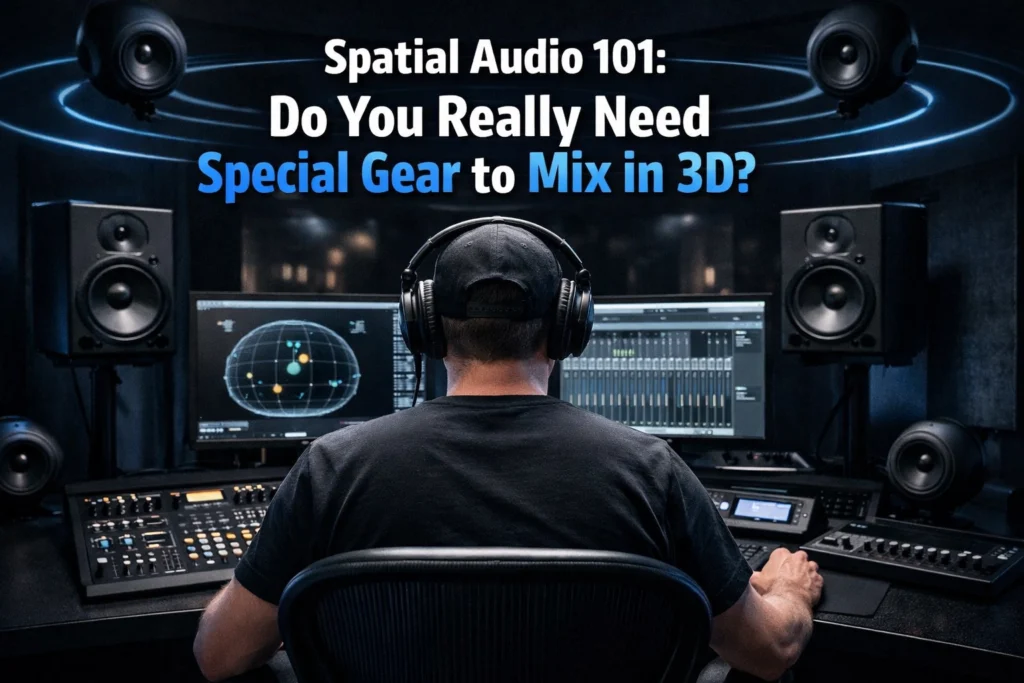
Spatial audio technology has transitioned from theatrical environments to music production workflows. The format allows audio elements to be positioned in three-dimensional space, creating immersive listening experiences. This shift raises practical questions about equipment requirements and implementation costs for audio professionals and content creators.
Understanding Spatial Audio Fundamentals
Spatial audio differs from traditional stereo or surround formats by treating individual sound sources as objects that can move freely in three-dimensional space. Standard stereo mixes position sound across a left-right plane. Spatial audio adds height and depth dimensions, allowing precise placement of instruments, vocals, and effects throughout the listening environment.
Dolby Atmos represents the current industry standard for spatial audio in both music production and post-production applications. Apple Music, Tidal, and Amazon Music now support Atmos playback, expanding the commercial viability of spatial mixes. The format has established technical specifications that determine monitoring requirements and workflow considerations.

Professional Studio Configuration Requirements
The recommended professional monitoring configuration for Dolby Atmos music production is 7.1.4. This designation indicates seven speakers positioned at ear level, one subwoofer for low-frequency management, and four height speakers installed at or near ceiling level. This configuration provides adequate coverage for accurate spatial placement decisions.
Audio interface requirements scale directly with speaker count. A 7.1.4 system requires twelve discrete outputs minimum. Additional outputs support alternate monitoring options and reference systems. Professional implementations often specify 16 or more outputs to accommodate workflow flexibility.
Speaker selection and calibration requirements exceed standard stereo monitoring practices. All speakers in the array must exhibit matched timbral characteristics to ensure consistent response as audio objects transition between positions. Time alignment calibration compensates for physical distance variations between listening position and individual speakers. Room acoustic treatment addresses reflection patterns and frequency response irregularities that affect spatial imaging accuracy.
Budget-Conscious Implementation Approaches

Complete professional monitoring systems represent significant capital investment. Alternative approaches provide entry points for spatial audio production at reduced cost levels.
Headphone monitoring offers immediate spatial audio capability without room modifications or multiple speaker installations. Current headphone models with spatial audio support include Apple AirPods Max, Sony WH-1000XM5, and Sennheiser HD 660S2. These devices utilize binaural processing to simulate three-dimensional positioning through standard stereo driver configurations.
Headphone monitoring introduces specific limitations. Individual ear anatomy affects spatial perception accuracy. Extended headphone sessions cause listener fatigue more rapidly than speaker monitoring. Critical mix decisions benefit from speaker verification, even when primary monitoring occurs through headphones.
Scaled speaker configurations provide intermediate options between headphones and full professional arrays. A 5.1.4 configuration reduces ear-level speakers from seven to five while maintaining height information. Some producers implement 5.1.2 systems with two height speakers instead of four. These reduced configurations decrease equipment costs and installation complexity while preserving basic spatial capabilities.
Software and Digital Audio Workstation Requirements
Spatial audio production requires compatible software environments. Logic Pro X includes native Dolby Atmos rendering capabilities with specific configuration parameters. The software requires frame rate settings at 24 fps for music mixing applications. Pro Tools supports Atmos production through the Dolby Atmos Production Suite plugin. These tools operate within existing DAW frameworks, integrating spatial capabilities into established workflows.
Third-party plugins expand spatial processing options beyond native DAW features. DearVR Pro, Waves Nx, and Halo Upmix provide object positioning, room simulation, and stereo-to-spatial conversion functionality. These tools operate on standard stereo monitoring systems during production, with spatial rendering occurring during export or streaming.
Core Equipment Versus Optional Enhancements
Essential spatial audio production requirements include an audio interface with adequate output channel count and either appropriate speaker configuration or spatial-capable headphones. DAW software with spatial rendering support completes the minimum viable setup. These components enable functional spatial mix creation and monitoring.
Optional enhancements improve workflow efficiency and mix accuracy without representing absolute requirements. Bass management systems optimize low-frequency response across multiple listening positions. External monitor controllers provide simplified speaker calibration and routing. Acoustic measurement tools facilitate room correction and speaker alignment procedures. Video monitoring displays support visual object positioning in production software interfaces.
The distinction between essential and optional equipment depends on production goals and delivery requirements. Professional studio facilities serving multiple clients require comprehensive monitoring configurations. Individual producers creating spatial content for specific platforms may achieve adequate results with simplified systems.

Practical Recommendations for Different Production Scenarios
Home studio operators beginning spatial audio exploration should prioritize compatible headphones and DAW software updates. This approach minimizes initial investment while establishing basic spatial production capability. Gradual system expansion can add height speakers and expanded interface options as project requirements and budgets develop.
Professional facilities adding spatial capability to existing stereo environments benefit from modular implementation approaches. Initial installations might add height speakers to current 5.1 configurations, creating 5.1.4 systems. Interface upgrades support expanded output requirements. Subsequent expansions add ear-level speakers to reach 7.1.4 specifications as client demand increases.
Mobile production applications present distinct challenges. Headphone monitoring provides reliable spatial reference across changing environments. Compact interface options support field recording and mixing without full monitoring arrays. Post-production verification occurs in controlled studio environments before final delivery.
Industry Adoption and Format Viability
Streaming platform support determines commercial spatial audio viability. Apple Music's Spatial Audio initiative has accelerated format adoption across multiple genres. Major labels now release catalog titles in Atmos formats alongside standard stereo versions. Independent artists access spatial distribution through standard aggregator services.
Consumer playback device capabilities continue expanding. Smartphones, tablets, smart speakers, and automotive audio systems increasingly include spatial processing features. This distribution infrastructure supports spatial content creation as standard production practice rather than specialty application.
Implementation Timeline Considerations
Spatial audio production capability can develop incrementally rather than requiring complete workflow transformation. Initial headphone-based monitoring establishes basic skills and techniques. Speaker additions and interface upgrades occur as project requirements justify capital investment. This staged approach distributes costs across multiple budget cycles while maintaining continuous production capability.
Training requirements accompany equipment acquisition. Spatial mixing techniques differ from stereo practices in object placement, panning automation, and frequency distribution decisions. Industry workshops, online courses, and manufacturer training programs provide knowledge development resources. Skill acquisition timelines should inform equipment purchase schedules to ensure effective utilization of new capabilities.
Conclusion
Special equipment requirements for spatial audio production exist but vary significantly based on application context and production standards. Professional studio implementations demand comprehensive monitoring configurations with specific technical specifications. Budget-conscious producers can achieve functional spatial production capability through headphone monitoring and scaled speaker configurations.
The decision to invest in spatial audio capability should consider current client requirements, anticipated format adoption trends, and existing equipment inventory. Incremental implementation approaches provide flexibility for studios evaluating long-term spatial production commitments. The essential insight remains that spatial audio production is accessible at multiple investment levels, with equipment choices scaling to match specific project needs and quality standards.
For questions regarding professional audio equipment selection and spatial audio implementation, contact our team for technical consultation services.