

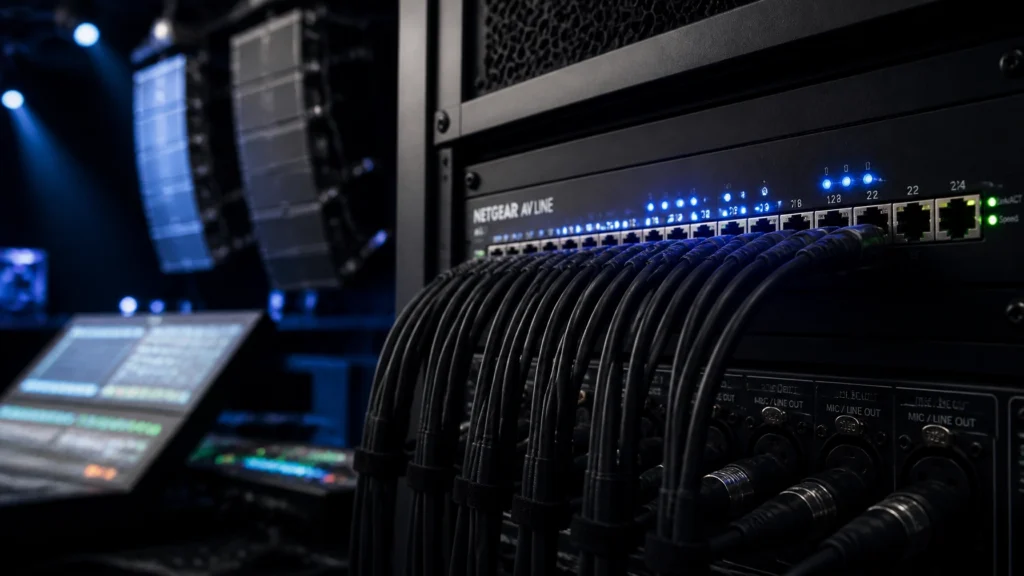
Professional audio distribution has shifted from traditional analog cabling to networked solutions. Selecting the correct protocol is essential for long-term venue stability and performance. Two primary technologies currently dominate the market: Dante and Milan. This article provides a technical comparison to assist in determining the most suitable choice for professional sound solutions.
The Role of Networked Audio in Modern Venues
Networked audio, or Audio over IP (AoIP), allows for the transmission of hundreds of high-quality audio channels over a single Ethernet cable. This technology reduces installation costs, simplifies routing, and enables complex system configurations that were previously impossible with analog infrastructure. For sound systems for musicians and venues, the choice of protocol dictates the hardware requirements and the overall reliability of the signal chain.
Dante: The Industry Standard for Versatility
Dante, developed by Audinate, is a proprietary protocol that operates at Layer 3 of the OSI model. It is the most widely adopted networked audio solution in the world. Because it is IP-based, it can function on standard off-the-shelf Ethernet switches, provided they are managed and configured correctly for Quality of Service (QoS).
Key Characteristics of Dante:
- Widespread Ecosystem: Dante is integrated into thousands of products from hundreds of manufacturers, including consoles, amplifiers, and digital signal processors.
- Layer 3 Compatibility: It can traverse routers and different subnets, making it suitable for large-scale converged building networks.
- User Interface: The Dante Controller software provides a standardized, intuitive method for routing audio across the network.
- Hardware Requirements: It runs on standard gigabit switches, though IGMP snooping and QoS settings are necessary for larger deployments.
For more information on comparing digital protocols to traditional methods, refer to our guide on Dante vs. Analog Snakes.

Milan: The Deterministic Open Standard
Milan is a pro-audio profile based on the IEEE Audio Video Bridging (AVB) and Time-Sensitive Networking (TSN) standards. Unlike Dante, Milan is an open standard managed by the Avnu Alliance. It operates at Layer 2 and is designed to provide guaranteed delivery of time-sensitive data.
Key Characteristics of Milan:
- Deterministic Performance: Milan uses the Stream Reservation Protocol (SRP) to reserve bandwidth. This ensures that audio traffic is never interrupted by other network data, providing a mathematical guarantee of latency and delivery.
- Plug-and-Play Reliability: Because the network management is built into the AVB-compliant switches, manual configuration of QoS or IGMP is not required.
- Certification: Every Milan-certified device is guaranteed to interoperate with other Milan devices, ensuring a stable and predictable ecosystem.
- Clocking Precision: It utilizes gPTP (Generalized Precision Time Protocol) for nanosecond-level synchronization between devices.
Technical Comparison: Dante vs. Milan
| Feature | Dante | Milan (AVB) |
|---|---|---|
| Layer | Layer 3 (IP-based) | Layer 2 (Ethernet-based) |
| Standard | Proprietary (Audinate) | Open Standard (IEEE/Avnu) |
| Switch Requirements | Standard Managed Switches | AVB-Certified Switches |
| Latency | Low (Buffer-dependent) | Guaranteed Deterministic |
| Configuration | Manual QoS & IGMP | Automatic Reservation |
| Market Adoption | Very High | Growing (High-end Pro Audio) |

Infrastructure and Hardware Considerations
The choice between these protocols significantly impacts the selection of audio gear.
Dante Infrastructure
Dante is highly flexible. It is the preferred choice for venues that already possess a robust IT infrastructure or those that require maximum compatibility with various brands of pro audio equipment. However, as the network grows, manual management becomes complex. Incorrect switch settings can lead to clocking errors or audible dropouts. Proper network engineering is mandatory for mission-critical Dante systems.
Milan Infrastructure
Milan requires a specific hardware ecosystem. Every switch in the audio path must be AVB-certified. While this can increase initial costs, it removes the need for specialized network engineering on a day-to-day basis. Once the AVB fabric is established, adding or moving devices is straightforward, as the switches handle the traffic management automatically.
Latency and Synchronization
In live performance environments, latency is a primary concern. Dante offers very low latency, often below one millisecond in small configurations. However, this latency is "best-effort" and can be affected by network congestion if QoS is not perfectly implemented.
Milan provides "bounded" latency. By reserving bandwidth at the hardware level, the protocol guarantees that every packet will arrive within a specific timeframe, regardless of other network activity. This makes Milan particularly attractive for large-scale touring systems and high-end performing arts centers where timing precision is non-negotiable.

Selecting the Right Protocol for Your Venue
The decision should be based on existing infrastructure, budget, and the specific requirements of the sound system.
Choose Dante if:
- You require the widest possible selection of hardware from different manufacturers.
- The audio system must share a converged network with general IT or video traffic.
- Your technical staff is proficient in standard IT networking and managed switch configuration.
- You are upgrading an existing facility and want to avoid replacing all networking hardware.
Choose Milan if:
- You are building a dedicated high-performance audio network from the ground up.
- Deterministic, guaranteed latency is a critical requirement for your performances.
- You prefer a plug-and-play network environment that does not require manual QoS tuning.
- You are utilizing high-end speaker systems from manufacturers that have prioritized Milan integration (e.g., d&b audiotechnik, L-Acoustics, Meyer Sound).
Avoiding common mistakes when buying music equipment involves understanding these technical nuances before committing to a protocol.
Conclusion
Both Dante and Milan offer robust solutions for modern audio networking. Dante provides unparalleled flexibility and market penetration, while Milan offers a standardized, deterministic approach to reliability. JAMMIN' Sound Solutions provides the expertise and equipment necessary to implement either technology successfully. For professional venues, the selection should align with the long-term operational goals and the specific demands of the audio environment.