

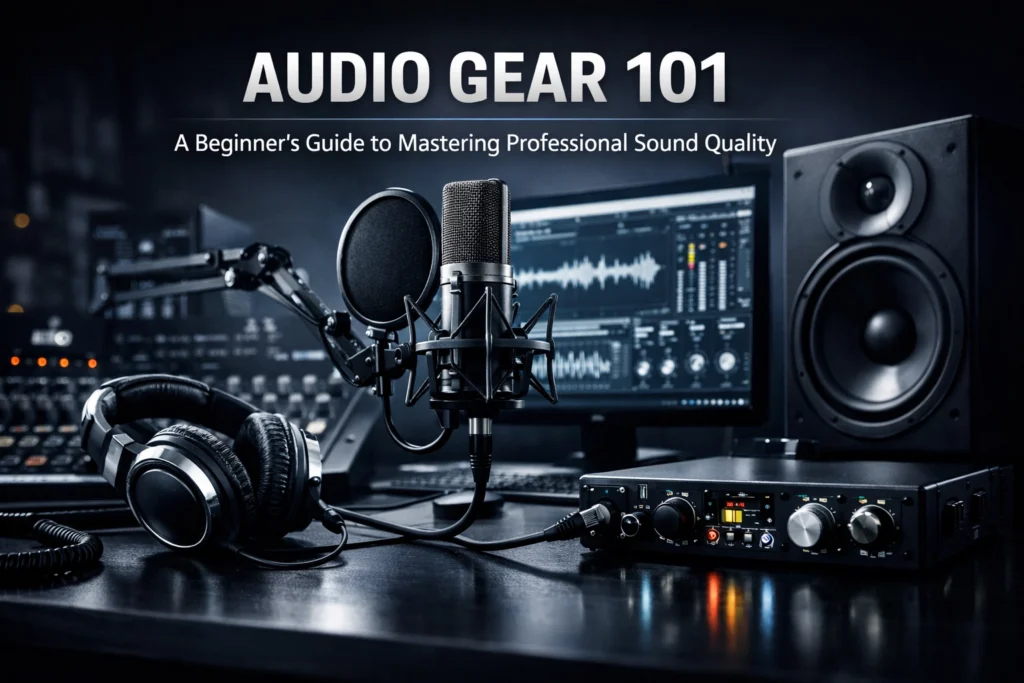
Professional sound quality requires understanding the fundamental components and signal flow of audio systems. Every system operates through three stages: input (sound sources), processing (control and manipulation), and output (amplification and reproduction). This guide provides technical information on components, setup procedures, and operational best practices.
Understanding Audio System Components
Microphones
Microphones convert acoustic energy into electrical signals. Dynamic microphones function optimally in live performance environments due to their durability and ability to handle high sound pressure levels. These units excel for vocal applications and instrument amplification where rugged construction is required.
Condenser microphones provide superior transient response and frequency accuracy. Studios and recording environments utilize condenser technology when capturing detailed sonic information. These microphones require phantom power (typically 48V) supplied through the mixer or preamp.
Wireless lavalier microphones deliver mobility for presenters and performers who require hands-free operation. These systems consist of a transmitter, receiver, and microphone element operating on specific radio frequencies.

Mixers and Signal Processing
Mixers function as the control center for audio systems. Each input channel provides gain control, equalization, auxiliary sends, and routing options. Digital mixers incorporate onboard processing, routing flexibility, and recall capabilities. Analog mixers offer direct tactile control and straightforward signal paths that facilitate learning fundamental audio concepts.
Channel strips typically include:
- Preamp gain for setting input levels
- High-pass filters to remove low-frequency rumble
- Multi-band EQ for tonal adjustment
- Auxiliary sends for monitor mixes and effects
- Pan controls for stereo placement
- Fader for overall level control
Amplifiers and Speakers
Speakers convert electrical signals into acoustic energy. Active speakers contain integrated amplification, requiring only power and audio signal connections. This configuration simplifies installation and ensures matched amplifier-to-driver specifications.
Passive speakers require external amplification. These systems demand proper impedance matching between amplifiers and speaker loads. Power handling specifications must align to prevent equipment damage and ensure adequate headroom.

Speaker driver configuration determines frequency reproduction capability:
- Woofers reproduce low frequencies (typically 40-500 Hz)
- Midrange drivers handle mid frequencies (500-5000 Hz)
- Tweeters produce high frequencies (5000-20,000 Hz)
Frequency response specifications indicate the range of frequencies a speaker can reproduce and the deviation from flat response across that range. Room size, ceiling height, and acoustic treatment affect speaker selection and placement requirements.
Digital-to-Analog Converters
DACs convert digital audio data into analog signals for amplification and reproduction. Audio interfaces and standalone DAC units affect the accuracy of digital-to-analog conversion. Bit depth and sample rate specifications determine resolution and frequency range. Professional applications typically utilize 24-bit/48kHz or higher specifications.
Cables and Connectivity
Signal integrity depends on proper cable selection and termination. Balanced XLR and TRS connections provide noise rejection for long cable runs and electrically noisy environments. Unbalanced TS and RCA connections function adequately for short distances in controlled settings.
Speaker cables must provide adequate conductor gauge for the power levels and cable length involved. Insufficient gauge creates resistance that reduces amplifier damping factor and power delivery.

System Setup Procedures
Planning and Layout
Document system requirements before equipment purchase or installation. Consider:
- Number and type of input sources
- Processing requirements (EQ, compression, effects)
- Output coverage area and SPL requirements
- Power availability and distribution
- Cable routing paths
Speaker placement affects coverage uniformity and feedback potential. Position main speakers to provide direct sound to the listening area. Avoid placement in corners or against walls unless compensating with EQ adjustments.
Connection Sequence
Connect components in logical signal flow order:
- Input devices (microphones, instruments, playback sources) to mixer input channels
- Mixer main outputs to amplifier inputs or active speaker inputs
- Amplifier outputs to passive speaker inputs (observing polarity)
- Monitor/auxiliary outputs to stage monitors or effects processors
Label all connections at both ends using tape or cable tags. Documentation simplifies troubleshooting and system modifications.
Power-Up Protocol
Follow proper power sequencing to prevent equipment damage:
- Set all mixer faders and gain controls to minimum position
- Power on signal sources and mixer
- Power on amplifiers and active speakers (with volume controls at minimum)
- Gradually increase levels to working position
Reverse this sequence during shutdown. Never power on amplifiers with input signals present or mixer channels at operating levels.

Sound Check Procedures
Test each input channel independently:
- Speak or play through the source at performance level
- Adjust preamp gain until the channel meter shows appropriate level (typically -12 to -6 dB average)
- Apply EQ adjustments to address frequency imbalances
- Set channel fader to unity gain (0 dB)
- Adjust main output to achieve desired SPL
Walk the coverage area during sound check. Verify consistent level and tonal balance throughout the listening space. Address dead spots through speaker repositioning or additional coverage speakers.
Operational Best Practices
Gain Structure
Proper gain staging maintains signal-to-noise ratio and prevents distortion. Set gain controls to achieve healthy meter readings without clipping. Each stage in the signal chain should operate with adequate headroom (6-12 dB below maximum level).
Equalization Technique
Apply EQ correctively rather than creatively in sound reinforcement applications. High-pass filters on vocal microphones reduce proximity effect and handling noise. Narrow cuts address feedback frequencies. Broad boosts compensate for room acoustics or speaker deficiencies.
Common EQ adjustments:
- 80 Hz high-pass filter on vocals removes rumble and stage noise
- Reduce 250-500 Hz to minimize muddiness
- Boost 3-5 kHz for vocal presence and intelligibility
- Reduce 8-12 kHz if sibilance becomes excessive
Component Matching
System performance depends on component compatibility. Impedance mismatches between amplifiers and speakers reduce power transfer and damping factor. Mismatched sensitivity between components creates gain structure problems.
The weakest component in the signal chain limits overall system quality. Balanced upgrades across all system elements produce better results than expensive components in one category paired with inadequate equipment elsewhere.

Cable Management
Organize cables using velcro ties or cable wraps. Separate power cables from audio cables to minimize noise induction. Coil cables properly to prevent kinking and internal conductor damage. Store cables in a manner that prevents strain on connectors.
Feedback Prevention
Feedback occurs when amplified sound from speakers re-enters microphones at sufficient level and phase to create regeneration. Prevention strategies include:
- Position speakers in front of microphones
- Reduce monitor levels to minimum required levels
- Use cardioid or hypercardioid polar patterns to reject sound from behind
- Apply narrow EQ cuts at feedback frequencies
- Reduce overall system gain
Conclusion
Professional sound quality results from systematic component selection, proper installation procedures, and disciplined operational practices. Understanding signal flow, gain structure, and basic acoustic principles enables effective system design and operation. Equipment quality matters, but proper implementation of mid-level components produces superior results compared to poorly configured high-end gear.
Additional technical resources and equipment specifications are available at JAMMIN' Sound Solutions. Component selection guidance and system design consultation address specific application requirements.