

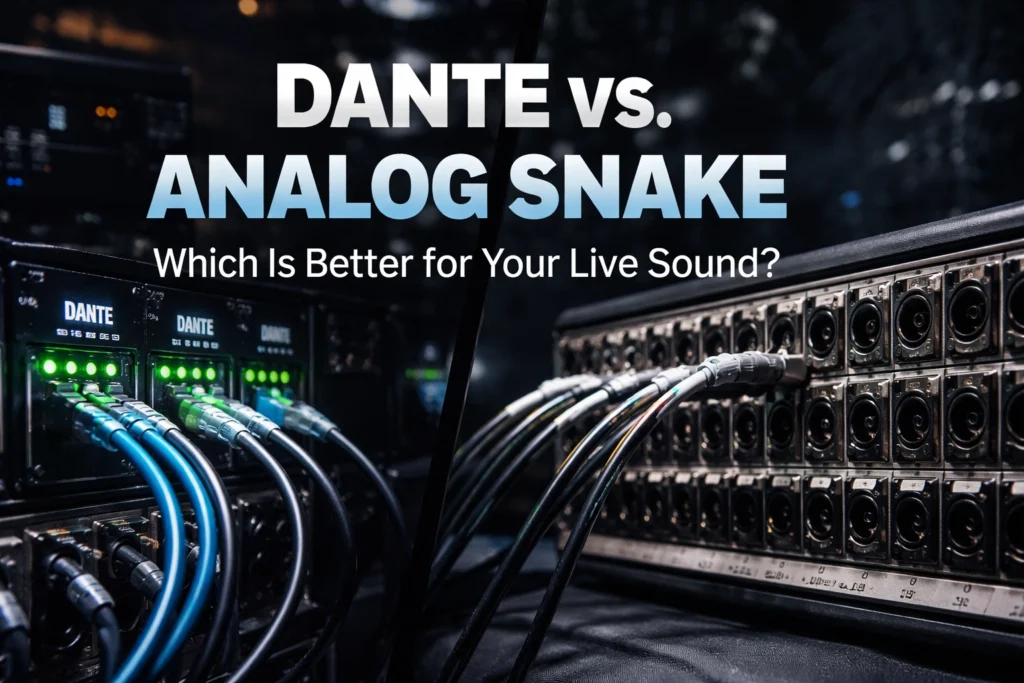

Choosing between Dante and analog snakes is a fundamental decision for any live sound setup. Both options serve the same basic purpose: transmitting audio signals from the stage to the front-of-house mixing position: but they accomplish this task in fundamentally different ways.
This comparison examines the technical specifications, practical considerations, and cost implications of each approach to help inform purchasing decisions for venues, houses of worship, touring productions, and other live sound applications.
Understanding Analog Snakes
An analog snake is a multi-channel audio cable that bundles multiple individual audio lines into a single, manageable package. A standard analog snake consists of a stage box with multiple XLR inputs and outputs, connected via a thick cable to a fan-out at the mixing console position.
Analog snakes have been the standard in pro audio equipment for decades. The technology is straightforward: each channel requires its own dedicated copper conductor pair running the entire length of the snake. A 32-channel analog snake contains 32 individual shielded cable pairs within its outer jacket.
The advantages of analog snakes include:
- Simple, proven technology with no learning curve
- No power requirements at the stage box (passive models)
- Immediate troubleshooting: signal either passes or it doesn't
- No latency concerns
- Lower initial cost for basic setups
However, analog snakes present several limitations. The cables are heavy and bulky, making load-in and load-out labor-intensive. Channel count is fixed at the time of purchase, and expanding the system requires running additional snakes. Signal degradation can occur over long cable runs, and diagnosing intermittent problems in a multi-pair cable can be time-consuming.

Understanding Dante
Dante (Digital Audio Network Through Ethernet) is a networking protocol developed by Audinate that transmits uncompressed, multi-channel digital audio over standard Ethernet networks. The technology has become the industry standard for modern live sound installations and touring productions.
A typical Dante setup consists of Dante-enabled stage boxes, mixing consoles, amplifiers, and other audio gear connected via standard CAT5e or CAT6 Ethernet cables and network switches. The Dante Controller software provides centralized routing and configuration management.
Key technical specifications of Dante include:
- Up to 512 bi-directional audio channels per network connection
- Sample rates up to 192kHz at 32-bit resolution
- Latency as low as 150 microseconds over 10 hops
- Automatic device discovery and clock synchronization
- Support from over 500 manufacturers
The protocol uses standard IT networking infrastructure, which means installation teams can leverage existing network knowledge and equipment.
Cable Management Comparison
The difference in physical infrastructure between Dante and analog systems is substantial. A 48-channel analog snake can weigh over 200 pounds and requires significant physical effort to deploy across a venue. The cable diameter makes routing through conduits and around obstacles challenging.
A Dante system accomplishes the same channel count: and far more: using a single Ethernet cable weighing a few pounds. A shielded CAT6 cable runs approximately 1/4 inch in diameter, compared to 1.5 inches or more for a large analog snake.
For permanent installations, this difference translates to reduced labor costs and simpler infrastructure requirements. For touring productions, it means faster setup times and less truck space dedicated to cable.
Audio Quality and Performance
Analog audio transmission is subject to several quality-degrading factors over distance. Capacitance between conductors causes high-frequency rolloff on long runs. Electromagnetic interference from nearby power cables, lighting dimmers, and RF sources can introduce noise. These issues compound with cable length and the number of connection points.
Dante transmits audio digitally, meaning the signal arriving at the destination is bit-for-bit identical to the signal that left the source, regardless of cable length (within Ethernet specifications). The protocol supports studio-quality resolution up to 192kHz/32-bit, though most live applications use 48kHz/24-bit.
Latency is a consideration in any live sound system. Analog systems have effectively zero latency: the signal propagates at near the speed of light through copper. Dante introduces measurable latency, but the default setting of 1 millisecond is imperceptible to performers and audiences. Lower latency settings are available for applications requiring tighter timing.
Scalability and Flexibility
Expanding an analog system requires physical cable runs. Adding eight channels to a 32-channel analog snake means either replacing the entire snake with a 40-channel version or running a separate 8-channel snake alongside the existing one. Both options involve significant cost and labor.
Dante systems scale by adding network-connected devices. Connecting an additional 8-channel stage box to an existing network switch immediately makes those channels available for routing. The Dante Controller software handles configuration without requiring physical repatching.

This flexibility extends to routing. In an analog system, changing which stage input connects to which console channel requires physically moving cables at the stage box or using a patch bay. Dante routing changes are made in software, allowing complete system reconfiguration in seconds.
For venues hosting varied events: concerts one night, corporate presentations the next: this flexibility has significant operational value.
Cost Considerations
Initial equipment costs favor analog systems for small, simple installations. A quality 16-channel analog snake costs less than an equivalent Dante stage box and the networking infrastructure required to support it.
However, total cost of ownership shifts toward Dante as systems grow in complexity. Considerations include:
Infrastructure costs: Analog systems require dedicated audio cabling infrastructure. Dante systems can share network infrastructure with other building systems, reducing installation costs.
Expansion costs: Adding channels to analog systems requires new cable purchases. Dante expansion requires only additional networked devices.
Labor costs: Lighter cables and faster setup times reduce crew requirements and load-in duration.
Maintenance costs: Ethernet cables and connectors are commodity items with lower replacement costs than specialized audio cable.
For professional sound solutions in mid-to-large-scale venues, the long-term economics generally favor Dante despite higher initial equipment investment.
Reliability Considerations
Both technologies have distinct reliability profiles. Analog systems fail in predictable ways: broken conductors, damaged connectors, intermittent connections. Troubleshooting follows established procedures, and partial failures (one bad channel) don't affect other channels.
Digital systems present different challenges. Firmware compatibility issues between devices from different manufacturers can cause unexpected behavior. Network configuration errors may result in complete system failure rather than degraded performance. However, when properly configured, Dante systems demonstrate excellent reliability across thousands of professional installations worldwide.

Redundancy options differ between the technologies. Dante supports automatic network redundancy with dual network connections, providing failover protection. Achieving similar redundancy with analog requires completely duplicating all cable runs.
Recommendations by Application
Small venues and basic applications: Analog snakes remain cost-effective for systems under 16 channels with fixed configurations.
Houses of worship: Dante provides flexibility for varying service formats and volunteer-operated systems where software-based routing simplifies operation.
Mid-to-large venues: The scalability and cable management advantages of Dante provide clear operational benefits.
Touring productions: Weight savings and setup speed improvements make Dante increasingly standard for professional touring audio gear.
Broadcast and recording integration: Dante's ability to route audio to recording systems, broadcast feeds, and streaming platforms simultaneously offers significant workflow advantages.
Conclusion
The live sound industry has moved decisively toward Dante for new installations and system upgrades. The technology addresses fundamental limitations of analog infrastructure while providing capabilities that analog systems cannot match.
Analog snakes continue to serve reliably in existing installations and budget-constrained applications. However, organizations planning new pro audio equipment purchases or system expansions should evaluate Dante as the foundation for future-ready infrastructure.
For assistance selecting the appropriate technology for specific applications, the team at JAMMIN' Sound Solutions provides consultation services for venues, houses of worship, and production companies evaluating their live sound infrastructure options.